CPF accrued interest and your real sale proceeds in Singapore
Almost every seller I meet knows their expected selling price. Very few know their cash proceeds. The gap between the two is usually CPF — the principal you withdrew for the home, plus the accrued interest those savings would have earned had you left them untouched. Here is exactly how that number is built, how quickly it compounds, and what it means for the home you buy next.
2.5%
The Ordinary Account floor rate used for accrued interest — unchanged every quarter since July 1999
Monthly
Interest is computed monthly and compounded annually, not monthly
28 years
How long a lump sum takes to double at 2.5% compounded annually
$220,400
Full Retirement Sum for members turning 55 in 2026 — the refund tops this up first
The mechanic
What accrued interest actually is
When you use CPF Ordinary Account savings for a property, that money stops earning the OA interest rate. CPF keeps a running tally of the interest you would have earned. On sale, you refund both the principal you used and that accrued interest back into your own CPF account.
Nothing is confiscated. The refund is still your money and can usually be used again for your next home. But it is not cash — and that is the part that catches sellers out when they are budgeting a down payment, stamp duty or a renovation.
Monthly computation, annual compounding — the detail most calculators get wrong
CPF computes interest monthly and compounds it annually, a method unchanged since 1986. A calculator that compounds monthly at 2.5% ÷ 12 will overstate your refund — by roughly 0.7% over 25 years. Small, but if you are budgeting to the last few thousand dollars, it is the wrong direction to be wrong in.
One more subtlety: CPF pays extra interest of 1% on the first $60,000 of your combined balances — capped at $20,000 of OA — and that extra interest is credited to your Special or Retirement Account, not your OA. Since accrued interest is the interest that would have been payable on the withdrawn OA savings, the sensible reading is that it is computed at the base OA rate alone, and that is what the calculator below does. CPF does not publish an explicit statement either way, so treat this as a reasoned assumption rather than a quoted rule.
The number
How fast it compounds
Here is $200,000 of CPF used for a home, and what you would owe back at each point if you had withdrawn it as a single sum.
What $200,000 of CPF grows into
Principal plus accrued interest at 2.5% per annum, compounded annually
5 yrs$226,282
10 yrs$256,017
15 yrs$289,660
20 yrs$327,723
25 yrs$370,789
30 yrs$419,514
At 28 years and one month, accrued interest equals the principal — the amount you owe back has doubled. By year 30 the interest alone is $219,514, more than the sum originally withdrawn.
Your real number will be lower than this — and that matters
The chart above is a teaching illustration: one lump sum on day one. Most owners do not withdraw that way. You take a lump for the down payment, then contribute monthly instalments over decades — and each instalment only starts accruing from its own withdrawal date. A dollar paid in year 14 has had one year to compound, not fifteen.
A realistic case: $30,000 upfront plus $810 a month for 15 years is $175,800 of principal and about $44,308 of accrued interest — roughly 25% on top, not the 45% the lump-sum chart shows at the same point. The calculator below models it properly.
Scope
What accrued interest applies to
Owners usually think of it as attaching to the down payment. It is broader than that.
CPF used for
Accrued interest?
What to know
Lump sum down payment
Yes
Accrues from the withdrawal date — the longest-running and usually largest component
Monthly loan instalments
Yes
Each instalment starts its own clock. Over 25 years this quietly becomes the biggest block of principal
Legal and conveyancing fees from CPF
Yes
Same basis
CPF housing grants
Yes
Grants and their accrued interest must be returned, and are already inside your stated refund figure. Above $30,000 of grants, part of the refund goes to your SA/RA and MediSave rather than your OA
Cash you paid from savings
No
Never entered CPF, so nothing accrues. This is why cash-heavy buyers keep more cash on exit
Buyer's Stamp Duty and ABSD
Yes
Both must be paid in cash first, then reimbursed from CPF subject to your withdrawal limits. Once reimbursed they accrue interest like any other withdrawal — the CPF cost is deferred, not avoided
The practical read
The more of your home you funded from CPF, the larger your eventual refund — and the smaller your cash on completion day. That is not an argument against using CPF; for most households it is the only way to buy. It is an argument for knowing the number before you plan the next move, not after an offer is on the table.
The arithmetic
The proceeds equation
Whether it is an HDB flat, a condo or a landed home, completion day looks the same. The order matters, because it determines who gets paid when there is not enough to go round.
The headline is $668,000. The cash is $252,800 — 38% of the sale price. The CPF refund of $220,108 is genuinely yours, but you cannot spend it on renovation, furniture, or the cash you must front for stamp duty.
Where the resale levy sits, if you owe one
If you are a second-timer buying another subsidised flat or an EC from a developer, the resale levy is deducted from the net proceeds of your first subsidised flat, with any shortfall payable in cash — and it ranks ahead of your CPF refund. You can defer it to your next purchase instead, but deferred levies carry interest at 5% per annum. If a levy applies to you, insert it in the waterfall above between the loan and the CPF refund.
If you hold a Plus or Prime flat, there is an extra deduction
Plus and Prime flats carry a subsidy clawback on first resale — a percentage of the resale price or valuation, whichever is higher, returned to HDB. The percentage is set per project, not universal, so check your own Agreement for Lease rather than a figure you read online. It is an additional deduction that does not appear in the waterfall above, and on a first-generation Plus or Prime flat it is large enough to change every number downstream of it.
The option fee is not yours to spend
CPF is unambiguous: any option money you receive from the buyer in cash — the option fee or the exercise fee — is considered part of the selling price and must be refunded to your CPF account before the transaction can be completed. Sellers routinely treat the $1,000 option fee as early spending money. If you used CPF for the property, it is not.
Run your own numbers
CPF accrued interest calculator
CPF accrued interest & sale proceeds calculator
Models CPF's actual method — interest computed monthly, compounded annually, with each monthly instalment accruing from its own date. Then runs the proceeds waterfall to your real cash figure. Everything runs in your browser; nothing is sent anywhere.
What this assumes
Accrued interest at 2.5% p.a., computed monthly and compounded annually — CPF's stated method. Extra interest is correctly excluded
The upfront amount accrues from month 1; each monthly instalment accrues from its own month
Grants are treated as received upfront and accrue on the same basis
Proceeds order follows CPF: the housing loan first, then the CPF refund computed on selling price less loan — agent and legal fees are not deducted before CPF. A market-value sale never requires a cash top-up to CPF, but it can leave nothing for your own costs
Does not model Plus/Prime subsidy recovery, a property pledge, part-share sales, or grants over $30,000 being split to SA/RA and MediSave
$220,108
Total CPF refund due — principal plus accrued interest
Principal $175,800Accrued interest $44,308
Full CPF refund clears and you walk away with $252,800 in cash.
If the sale price cannot cover the loan plus the full CPF refund, two very different things happen depending on which shortfall you have. Sellers conflate them, and the difference is the difference between an inconvenience and a cash call.
Everything clears
Sells at $668,000
Selling price$668,000
Less loan−$180,000
Less CPF refund−$220,108
Less fees−$15,092
Cash to you$252,800
The normal case. CPF fully refunded, loan cleared, cash in hand.
CPF shortfall — waived
Sells at $330,000, loan $180,000
Selling price$330,000
Less loan−$180,000
CPF takes the rest$150,000
CPF shortfall$70,108
You still owe fees$7,724
No cash top-up to CPF. The shortfall is written off. But CPF takes price less loan — fees are not deducted first — so your agent and lawyer are still paid from savings.
Loan shortfall — cash
Condo at $1.10m, loan $1.15m
Selling price$1,100,000
Less loan−$1,150,000
Loan shortfall$50,000
Plus fees$26,980
You must pay$76,980
This is real cash, due on completion. The waiver protects CPF, not your lender. The whole CPF refund is waived and you still write a cheque.
Two mechanics drive all three outcomes. First, order of priority: the outstanding housing loan ranks ahead of the CPF refund, so CPF absorbs whatever is left — including nothing. Your lender does not. Second, what CPF measures: the refund is computed on selling price less outstanding loan. Your agent commission and legal fees are not deducted before CPF gets its share — they come out of whatever remains afterwards, which in a thin sale can be nothing at all.
Selling to a family member below market value destroys this protection entirely
Where a member disposes of a property without consideration, or for a consideration below market value, the Regulations require the full principal plus accrued interest — the "lesser of net proceeds or P+I" test simply does not apply. A discounted transfer to a child or sibling therefore converts a waived shortfall into a cash liability for the entire refund. If you are contemplating an intra-family transfer, get this modelled before anything is signed.
Who should check this early rather than after an offer arrives: owners who bought at a market peak, owners who have held a large CPF-funded loan for many years, and anyone whose flat has a short remaining lease in an estate where prices have softened.
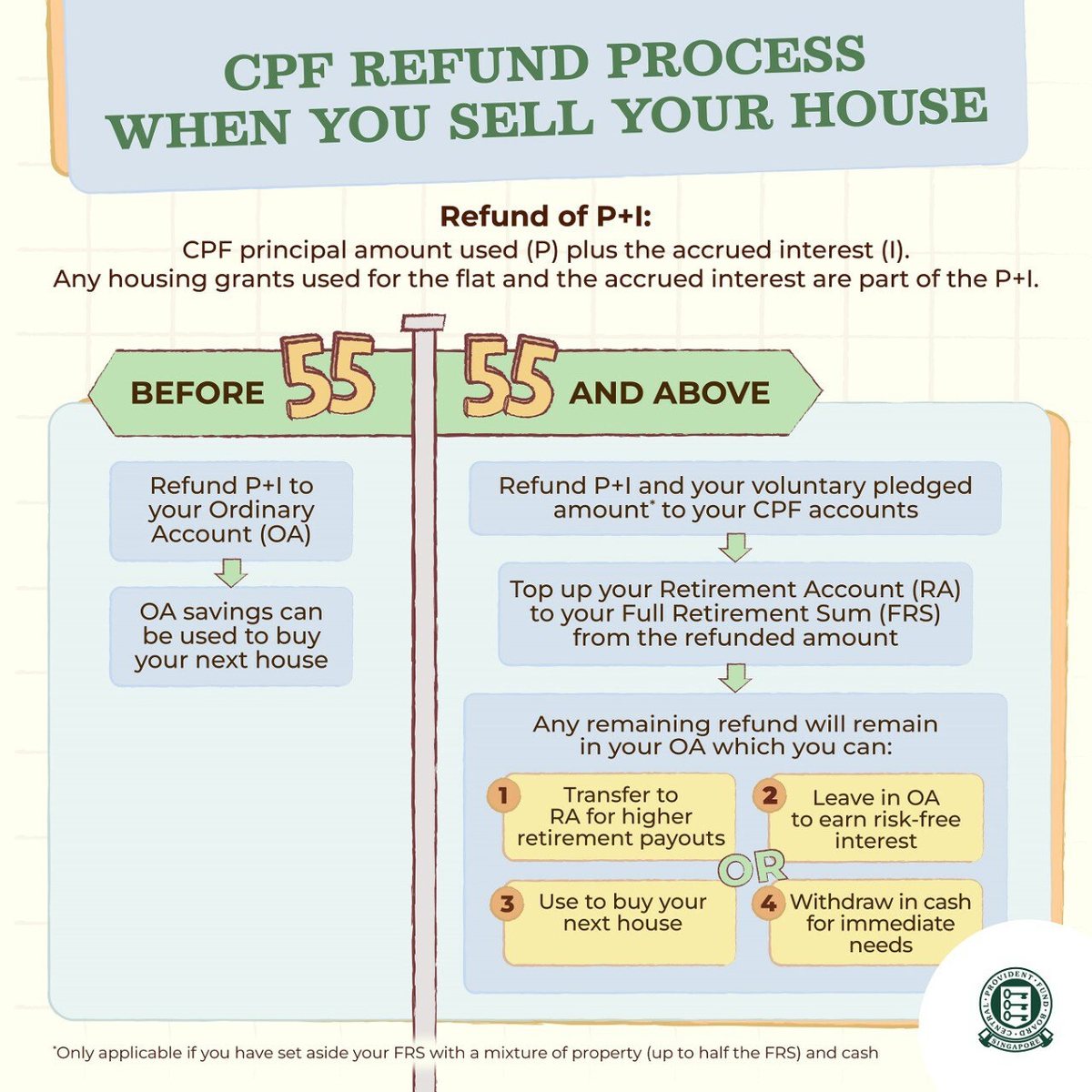
If you are 55 or older
Where the refund actually goes after 55
Your cash proceeds are unaffected by age — those are paid to you at completion either way. What changes is the destination of the CPF refund. Below 55, housing refunds are credited to your Ordinary Account. From 55, they first top up your Retirement Account to your required retirement sum, and only the balance stays in the OA. The target is the Full Retirement Sum — $220,400 for members turning 55 in 2026.
CPF retirement sums
Turning 55 in 2025
2026
2027
Basic Retirement Sum (BRS)
$106,500
$110,200
$114,100
Full Retirement Sum (FRS)
$213,000
$220,400
$228,200
Enhanced Retirement Sum (ERS)Current-year figure, open to all members 55+ — not fixed at 55
$426,000
$440,800
$456,400
The property pledge — an extra refund most people forget they made
If you are 55 or over and previously withdrew Retirement Account savings down to the BRS using your property to make up the difference, you may have signed a pledge to refund. In that case your sale-time obligation is not P+I — it is P + I + the pledged amount. Check your CPF statements before you build a budget around the refund figure you remember.
A carve-out worth knowing if you are much older
If you were aged 55 or older before 1 January 2013 and had already set aside your Full Retirement Sum before that date, only the principal used from 1 January 2013 onwards, plus its accrued interest, needs refunding. Your required refund may be materially smaller than a straight P+I calculation suggests.
Once the Retirement Account is topped up, remaining OA savings — including the balance of your housing refund — are withdrawable in cash for immediate needs. And if you are right-sizing to a 3-room or smaller HDB flat, RA savings above the BRS can be used for it, provided you buy within 3 years of selling, the new flat costs less than the sale price of the old one, and no CPF LIFE plan has been issued.
The next home
Using the refund again — and the three limits on it
"It can usually be used again for your next home" is true, and incomplete. The next property is assessed afresh against its own limits, and for an older or more expensive property those limits bite.
Property & loan
CPF you can use
Beyond that
New HDB flat direct from HDB, HDB loan
The full purchase price
No Valuation Limit, no Withdrawal Limit
Resale HDB flat, HDB loan
Up to the Valuation Limit — the lower of purchase price and valuation at purchase
May continue for the remaining housing loan if you have set aside your BRS. No 120% ceiling
HDB flat or private property, bank loan
Up to the Valuation Limit
Then up to a Withdrawal Limit of 120% of the VL, but only if you have set aside your BRS — $110,200 in 2026
The limit that overrides all of them: remaining lease
If the property's remaining lease covers the youngest owner using CPF to age 95, you get the full Valuation Limit. If it does not, a pro-rated cap applies instead — and CPF is explicit that this cap applies regardless of whether you have set aside your Basic Retirement Sum. Setting aside more money does not lift it.
CPF publishes no formula, but its own worked examples are consistent with pro-rating after stripping out the 20-year floor from both sides — roughly, the lease beyond 20 years as a share of the buyer's runway to 95 beyond 20 years. On CPF's published example, two 25-year-old buyers and a 65-year lease give 90% of the price, not the 93% a naive "runway covered" reading would suggest. There is also a hard floor: the remaining lease at purchase must be more than 20 years for CPF to be used at all.
A fresh clock starts
Accrued interest runs from the date you first used CPF for a given property until you refund it, and it is computed per property. Refunding on this sale stops the clock. When you use CPF for the next home, a new accrued interest clock starts from each new withdrawal — the old interest does not carry forward. Buying at 45 rather than 35 means a decade less compounding on the next property.
Buying before selling
If you are buying a second property before disposing of the first, the gate is higher: you generally need to set aside the Full Retirement Sum, not the BRS, before using excess OA savings — unless your existing property's lease already covers you to 95. Sequence matters here as much as it does for stamp duty, and this CPF gate is a separate test from the six-month ABSD refund window and from HDB's own disposal conditions. They are three different clocks.
Refunds are credited within up to 15 working days after completion. HDB's guidance for flat sellers indicates 7 to 14 working days from the resale completion appointment. Either way, plan on a fortnight — not same-day availability for your next down payment.
A live option
Should you refund voluntarily?
You can pay CPF back at any time, without selling. Doing so stops the accrued interest clock on the amount refunded and puts that sum back to work earning OA interest — which strengthens your retirement position and, when you eventually sell, increases your cash proceeds by exactly the interest you avoided.
It makes sense when
You have surplus cash with no better risk-adjusted use than a guaranteed 2.5%
You expect to hold the property for many more years, so the compounding you avoid is large
You are approaching 55 and want the refund working inside your retirement sums
It makes less sense when
You may need that cash within a few years — CPF does not return voluntary refunds on request
You are likely to sell soon, so there is little compounding left to avoid
You have higher-interest debt outstanding, which should be cleared first
The trade-off is liquidity, and it is one-way. Treat a voluntary refund as a decision about your retirement balance sheet, not a clever arbitrage.
In practice
What people get wrong
1
Treating the CPF refund as cash
It is your money and it will fund the next home's down payment. It will not fund agent commission, the minimum cash portion of a private purchase, renovation or furniture — and while stamp duty can be reimbursed from CPF afterwards, you must pay it in cash first. Keep two separate columns from the start.
2
Estimating accrued interest instead of pulling the actual figure
Your CPF Home ownership dashboard shows your exact principal and accrued interest. Every estimate — including the calculator above — is a planning tool. Once you are in a live transaction, use the real number.
3
Assuming the shortfall waiver covers the mortgage
It covers CPF only. A loan shortfall is cash owed to your lender on completion day. Owners who bought near a peak with a high loan-to-value should check this before they market, not after.
4
Spending the option fee
If you used CPF for the property, option monies received in cash count as part of the selling price and must be refunded to CPF before completion.
5
Forgetting that grants carry accrued interest too
A $50,000 grant received fifteen years ago is not a $50,000 refund. And grants over $30,000 are refunded partly to your Special or Retirement Account and MediSave — so less of it returns to the OA you were planning to spend.
6
Planning a family transfer without checking the below-market rule
Selling to a relative at a friendly price looks generous until CPF requires the full principal plus accrued interest in cash regardless of what changed hands.
Planning your next home around the number
Once you know your cash and your CPF refund separately, the upgrade question becomes concrete: which price band you can service, whether you need a bridging arrangement, and whether selling first or buying first is safer for your family. That conversation is far more useful than debating an asking price in the abstract.
If you want the figures verified against your actual CPF statement and loan balance, send me your details and I will prepare a written proceeds statement.
Questions
Frequently asked questions about CPF accrued interest
What is CPF accrued interest?
It is the interest your CPF savings would have earned had you left them in your Ordinary Account instead of using them for a property. CPF keeps a running tally, and on sale you refund both the principal you withdrew and that accrued interest into your own CPF account. Nothing is confiscated — the refund is still your money — but it is not cash, which is what catches sellers out.
How is CPF accrued interest calculated?
It is computed monthly and compounded annually at the prevailing Ordinary Account rate, which has been 2.5% per annum — the legislated floor — every quarter since July 1999. Interest accrues not only on the principal withdrawn but also on interest that has already accrued. A calculator that compounds monthly rather than annually will overstate your refund.
How long does it take for CPF accrued interest to double the amount I owe?
At 2.5% compounded annually, a lump sum doubles in just over 28 years. $200,000 withdrawn becomes about $256,000 after 10 years, $328,000 after 20 years and $420,000 after 30. Most owners withdraw progressively through monthly instalments rather than all at once, so the effective growth is slower — but the direction is the same.
Does accrued interest apply to CPF housing grants?
Yes. CPF states that housing grants received and their accrued interest need to be returned, and they are already included in your stated refund figure. Accrued interest also applies to the lump sum used for your down payment, to monthly instalments paid from CPF, and to stamp duty and legal fees paid from CPF. If you received more than $30,000 in grants, part of the refund goes to your Special or Retirement Account and MediSave rather than all to your Ordinary Account.
What happens if my property sells for less than my loan plus CPF refund?
If sold at market value, you refund only the selling price less the outstanding housing loan, and you do not top up the CPF shortfall in cash. But the outstanding housing loan ranks ahead of the CPF refund, so a shortfall on the loan itself is still your cash liability to the lender. The waiver covers CPF, not the bank.
Does the negative sale waiver apply if I sell to a family member?
No. Under the CPF Approved Housing Schemes Regulations, where a member disposes of a property without consideration or for a consideration below market value, the member must pay the full principal plus accrued interest — the lesser-of-net-proceeds-or-P+I protection does not apply. A gift or below-market transfer to a relative strips out the waiver entirely, and any shortfall must be funded in cash.
Do I have to refund the option fee to CPF?
Yes, if you used CPF for the property. CPF states that any option money received from the buyer in cash — option fee or exercise fee — is considered part of the selling price and must be refunded to your CPF account before the transaction can be completed. Sellers routinely spend it and are then surprised at completion.
Can I use the CPF refund again for my next home?
Usually yes, subject to fresh limits on the new property. CPF use is capped at the Valuation Limit — the lower of purchase price and valuation at the time of purchase. With a bank loan you may go beyond it up to a Withdrawal Limit of 120% of the VL, but only if you have set aside your Basic Retirement Sum ($110,200 in 2026). Separately, if the remaining lease does not cover the youngest owner using CPF to age 95, a pro-rated cap applies instead — and that one cannot be lifted by setting aside the retirement sum.
What happens to my CPF refund if I am 55 or older?
Your housing refund first tops up your Retirement Account to the Full Retirement Sum — $220,400 for members turning 55 in 2026 — and only the balance remains in your Ordinary Account. If you previously pledged your property to withdraw RA savings, you must also refund the pledged amount. Your cash proceeds are unaffected; those are paid to you regardless of age.
Should I make a voluntary housing refund to CPF?
It stops the accrued interest clock on the amount refunded and restores that sum to earning OA interest, strengthening your retirement position and increasing your eventual cash proceeds. The trade-off is liquidity — money returned to CPF cannot be spent, and CPF does not return voluntary refunds on request. It suits owners with surplus cash and a long remaining holding period; it suits owners who may need that cash within a few years far less.
How long does the CPF refund take after completion?
CPF credits refunds within up to 15 working days after the sale completes. HDB's guidance for flat sellers indicates the refund is arranged within 7 to 14 working days of the resale completion appointment. Plan on a fortnight rather than same-day availability.
Does accrued interest reset when I buy my next property?
Yes. Accrued interest runs from the date you first used CPF for a given property until you refund it, and it is calculated per property. Refunding on this sale stops that clock; using CPF for the next home starts a fresh one from each new withdrawal. The old accrued interest does not carry forward.
Sources & last verified
All rules and figures were verified against primary sources on 17 August 2026.
CPF Board: CPF refund when selling or transferring property; what happens to the sales proceeds after selling your home; selling before vs after age 55; using your CPF to buy a home; how much CPF savings you can use; the CPF retirement sums; voluntary housing refunds; withdrawal of RA savings for property owners; CPF interest rates and rate history.
Legislation: Central Provident Fund Act 1953, s 6(4); CPF (Approved Housing Schemes) Regulations, regs 8, 10 and 13 — including reg 13(3) (lesser of net proceeds or P+I), reg 13(4) (below-market disposal) and reg 13(12) (net proceeds, which ranks a non-deferred HDB resale levy ahead of the CPF refund).
HDB: mode of financing; resale completion and CPF refund timing; resale levy.
MND / MOM: joint press release, More Flexibility to Buy a Home for Life (9 May 2019) and its annexes on CPF usage and lease pro-rating; written answer on housing refunds to the Retirement Account (12 January 2026).
Disclaimer. CPF rules, retirement sums and housing policies change. This information is provided on a goodwill basis and does not relieve you of the responsibility to verify it with CPF Board, HDB and the relevant authorities, or to seek advice from financial advisers, bankers and lawyers. It is not financial, tax or legal advice and does not account for your personal circumstances. All worked examples are illustrative and rounded. Your own principal and accrued interest figures are available in your CPF Home ownership dashboard and should be used in place of any estimate here.
Disclaimer: Project information, pricing, promotions, availability, transaction figures, calculations and charts are provided for general information and research purposes. They are indicative, may not reflect real-time status, may change without notice and should be independently verified and confirmed before making a purchase decision. Historical transactions are for reference only and are not a valuation. Calculations are estimates only. Nothing on this website constitutes financial, legal or investment advice.
Wondering what this means for your own home?
Kaeden Ong 王天财, Associate Division Director at ERA Singapore and ERA top 1% award winning achiever, will prepare a free valuation for your HDB, condo or landed home — with the CPF refund and net cash proceeds spelled out before you decide anything.